
"Can you do better on price?"
Every wholesale merchant on Shopify hears this question daily. How you respond determines whether you build a profitable B2B business or race to the bottom. According to Shopify's B2B documentation, B2B buyers expect negotiation as part of the purchasing process — but that does not mean every deal requires a discount.
The tension is real: you need to win deals, but you cannot afford to give away margin. Discount too aggressively and you are working for free. Refuse to negotiate and you lose to competitors who are willing to flex. The solution is not about being the cheapest supplier — it is about negotiating strategically with the right tools and data behind you.
If you are new to B2B quoting on Shopify, start with the B2B quote management guide to understand the full workflow before diving into negotiation tactics.
When to Discount (And When to Hold Firm)
Not every price request deserves a discount. The key is knowing which situations justify a concession and which ones require holding your ground.
Situations Where Discounting Makes Sense
1. High-Volume Commitments. If a buyer commits to regular, large orders, lower per-unit margin can mean higher total profit. A 5% discount on a 1,000-unit recurring order is worth more than full margin on a one-time 50-unit purchase. Structure the discount so it is tied explicitly to the volume commitment.
2. Long-Term Contracts. Lock in business for 12 to 24 months with guaranteed revenue. The predictability of a contract justifies a modest price concession because you eliminate the acquisition cost of finding new buyers for that capacity.
3. Market Entry or Strategic Accounts. Some accounts open doors to an entire industry segment. If winning a buyer gives you credibility, case studies, or referrals that generate future business, an initial discount can be a strategic investment rather than a margin loss.
4. Cash Flow Optimization. Offer discounts for favorable payment terms — paying upfront, net-15 instead of net-60, or prepaying for quarterly shipments. The time value of money and reduced collection risk can offset the price reduction.
Situations Where You Should Hold Firm
1. Small Orders Without Growth Potential. Do not discount 100-unit orders from buyers who have no realistic path to scaling. You set a bad precedent that anchors every future conversation at the discounted price.
2. Customers Who Always Threaten to Leave. Serial negotiators who constantly threaten to switch suppliers usually will not leave — switching costs are high and they know it. Respond with empathy but hold your position.
3. When You Are Already the Best Value. If your product quality, delivery reliability, and service level already justify your pricing, emphasize total cost of ownership rather than matching a competitor's lower unit price.
Understanding when to discount and when to hold firm is closely tied to how you set up customer-specific pricing for different buyer segments.
The 5 Negotiation Tactics That Protect Margin
Tactic 1: Anchor High, Then Make Calculated Concessions
Always start with your list price, not your floor price. Let the buyer counteroffer. When you make a concession, make it small and conditional — "I can move 3% if you increase the order to 500 units."
Pro tip: Never give a unilateral concession. Every discount should come with a condition that increases the total value of the deal for you: larger volume, faster payment, longer contract, or bundled products.
Tactic 2: Offer Non-Price Value Instead of Discounts
When buyers push for lower prices, offer value that costs you less than a price cut but matters more to the buyer:
- Extended payment terms (net-60 instead of net-30)
- Free or expedited shipping
- Priority delivery scheduling
- Added services like custom labeling or kitting
- Product upgrades or samples of new lines
Cost to you: Often significantly less than a price cut. Perceived value to the buyer: Can exceed the discount they originally requested. Document these alternatives in your quote proposal so the buyer sees the full value on paper.
Tactic 3: Use Quantity Breaks to Encourage Larger Orders
Instead of: Flat discounts that reward small orders.
Do this: Transparent volume pricing with clear tiers.
Structure quantity breaks so buyers see a path to better pricing through larger commitments. For example: list price at 1-99 units, 5% off at 100-499, 10% off at 500-999, and 15% off at 1,000+. This shifts the negotiation from "give me a discount" to "how much do I need to order to reach the next tier?"
Quantity breaks increase average order value while making the buyer feel they earned the pricing through commitment rather than haggling.
Tactic 4: The "Competitor Comparison" Defense
When a buyer says "Company X quoted me $40 per unit":
Good response: "Let us compare what is included at that price." Then walk through the differences: product quality, delivery timelines, payment terms, return policies, warranty coverage, and after-sales support. Most "lower" competitor quotes exclude elements that your pricing includes.
Build a comparison into your proposal. A branded PDF quote that clearly itemizes what the buyer gets at your price makes the value tangible rather than abstract.
Tactic 5: The "Budget Authority" Technique
Your response: "I want to help you get the best pricing possible. Let me take this to our pricing team and see what I can do."
This accomplishes three things: it shows the buyer you are on their side, it buys you time to evaluate the deal properly, and it makes any concession you offer feel "earned" because it required internal approval. Even if you have pricing authority, introducing a review step prevents impulsive discounting.
How to Structure Discounts That Protect Margin
Rule 1: Always Tie Discounts to Conditions
Instead of: "Here is 10% off."
Say: "I can offer 10% off if you increase the order to 500 units, commit to quarterly reorders, or pay within 15 days."
Conditional discounts ensure every concession generates additional value for your business. They also create a framework the buyer understands — discounts are not arbitrary, they are earned.
Rule 2: Use Temporary Promotions, Not Permanent Price Cuts
"This pricing is valid through end of quarter" creates urgency and gives you the ability to return to standard pricing. Permanent price cuts are almost impossible to reverse. Temporary promotions keep your pricing power intact while still giving the buyer a reason to act now.
Rule 3: Create a "Win-Back" Budget
Set aside a small margin allocation for winning back lost customers. If you lose a buyer to a competitor offering a lower price, you can make an aggressive offer 6 to 12 months later when the competitor inevitably underdelivers on quality or service. Having a win-back budget means you do not panic-discount during the initial negotiation.
The Power of Walking Away
The hardest lesson in wholesale negotiation: Not every deal is worth winning.
If a buyer's price demands would put you below your minimum acceptable margin:
- Do the math. Calculate the true cost including production, shipping, overhead, and opportunity cost. Know your exact floor before the negotiation starts.
- Know your floor. What is the absolute minimum margin you can accept? Write this number down before the meeting and do not go below it.
- Be willing to walk. "At that price point, I cannot deliver the quality and service your business deserves. I would rather be honest about that now than let you down after the order is placed."
What often happens: The buyer comes back. Your willingness to walk away signals confidence in your value. It also tells the buyer that your pricing is real, not inflated with negotiation padding. Buyers respect suppliers who know their worth.
When a buyer does agree to your terms, the fastest way to lock in the deal is to convert quotes to Shopify draft orders immediately so there is no gap between agreement and order placement.
How AddToQuote Supports Your Negotiation Workflow
Negotiation is not just about conversation skills — it is about having the tools to execute professionally at every stage of the deal. AddToQuote gives Shopify merchants a structured negotiation workflow that replaces email threads and spreadsheets.
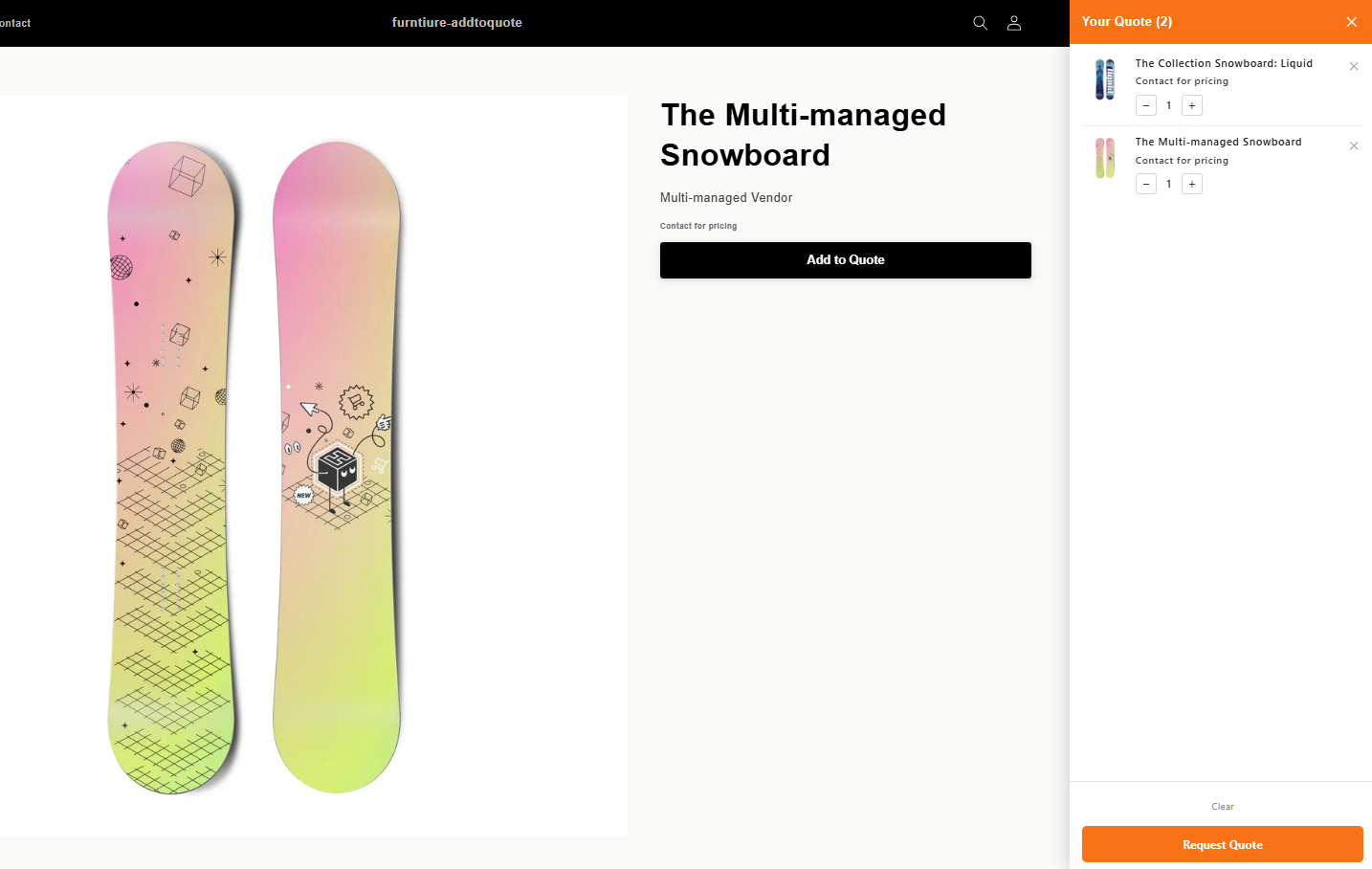
Quote request capture. A Request a Quote button appears on every product page in store-wide mode. Buyers browse your catalog, select products and quantities, and submit a structured quote request through a customizable form. No phone calls or email chains required.
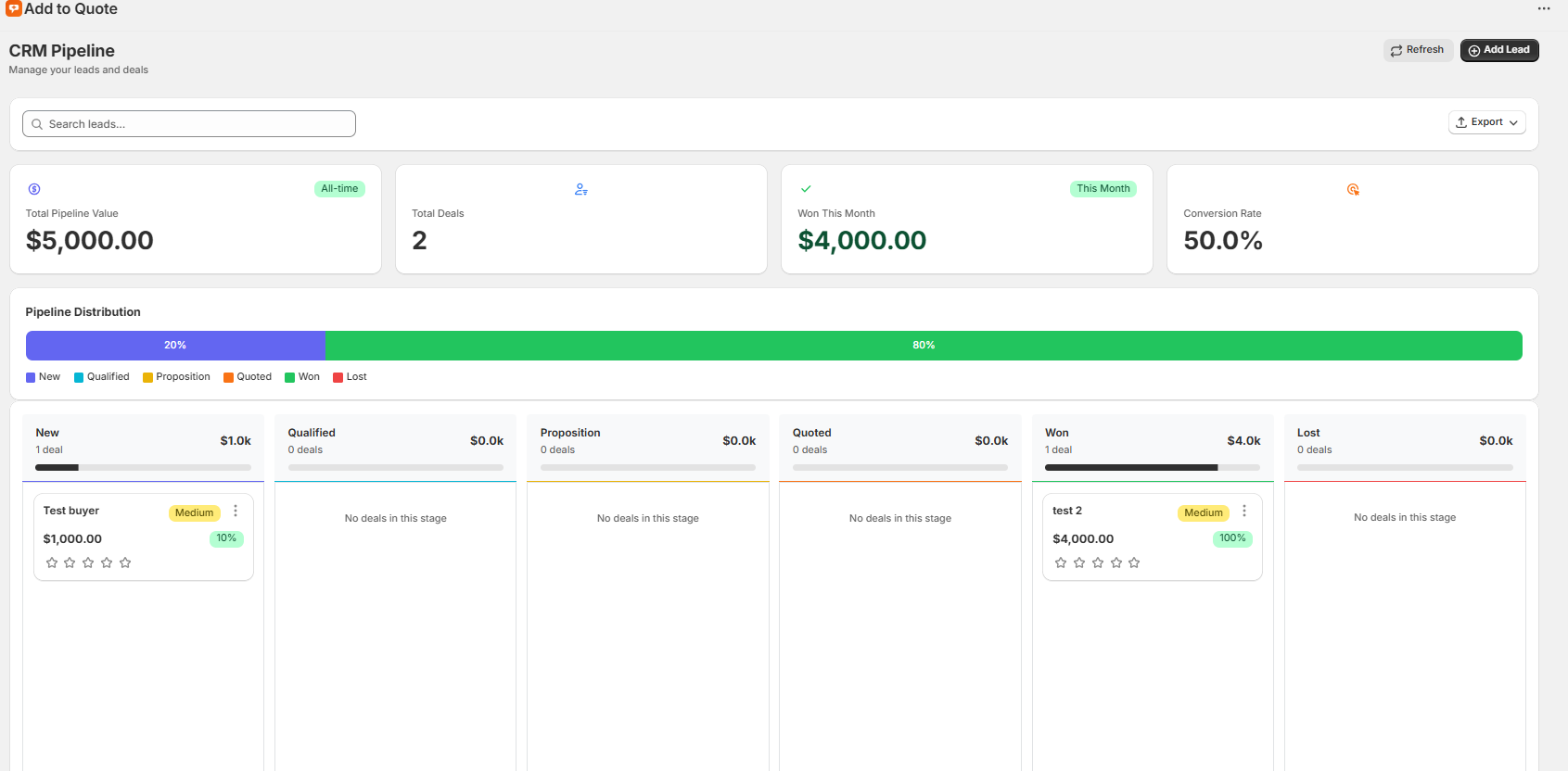
CRM pipeline tracking. Every negotiation moves through pipeline stages — New, Qualified, Proposition, Quoted, Won, Lost — giving your team visibility into exactly where each deal stands. When a quote stalls at "Quoted" for a week, the system flags it for follow-up. This is the same pipeline approach used in building a high-converting B2B sales funnel.
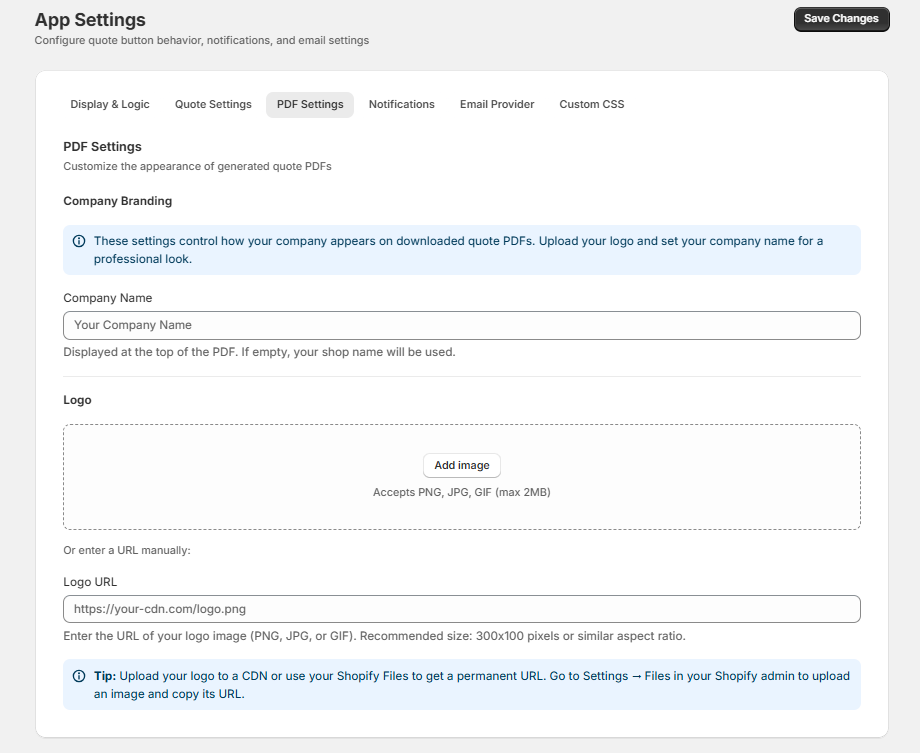
Branded PDF proposals. Generate professional price proposals with your logo, line items, custom per-customer pricing, payment terms, and your custom notes. A polished proposal reinforces that your pricing is deliberate and backed by a professional operation — not something that can be casually negotiated down.
One-click draft order creation. When the buyer accepts your terms, click Create Invoice to generate a Shopify draft order with every product, quantity, price, and customer detail transferred automatically. No manual re-entry means no gap between agreement and order placement.
Email notifications. Get alerts via your connected email provider (6 providers supported including Gmail and Outlook) so your team responds to new quote requests and negotiation updates within minutes. Speed of response is a negotiation advantage — the first supplier to respond professionally sets the benchmark.
Measuring Negotiation Success
Negotiation is a skill that improves with data. Track these metrics monthly to identify where your process is strong and where deals leak:
- Average discount given — Are discounts trending up or staying controlled?
- Quote-to-order conversion rate — What percentage of quoted deals close?
- Time to close — How many days from first quote to signed order?
- Average deal size — Are quantity breaks driving larger orders?
- Win rate by customer segment — Which buyer types convert at the highest rate?
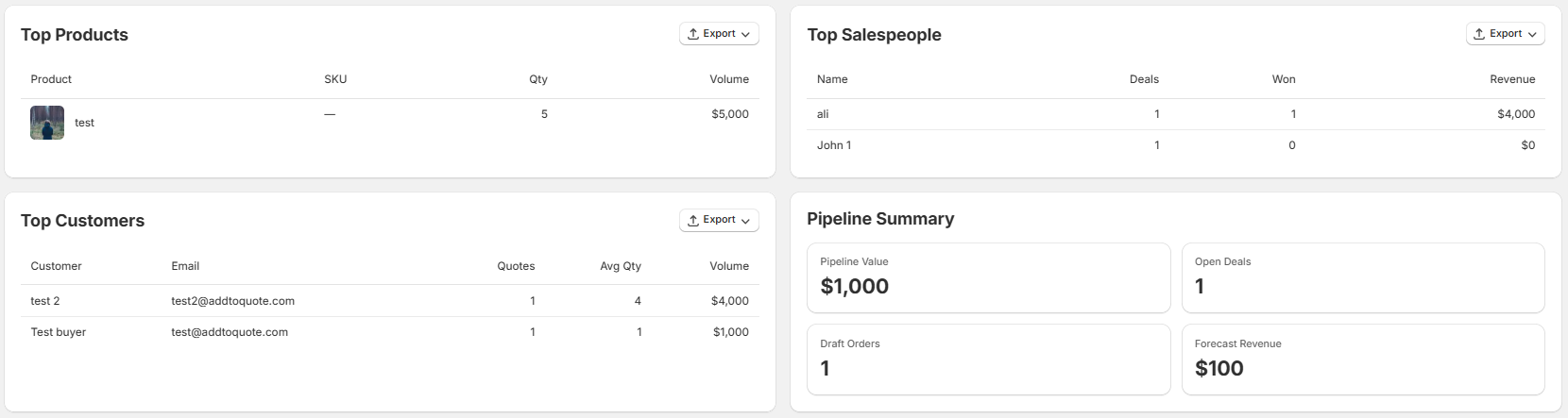
A quote management system with built-in analytics — like the essential features of a quote management system describes — gives you this data automatically instead of requiring manual tracking.
Frequently Asked Questions
How do I negotiate wholesale prices without losing margin?
Start with your list price and make small, conditional concessions — never give a discount without getting something in return such as a larger order, longer contract, or upfront payment. Use branded PDF proposals that itemize the value you deliver so the conversation stays focused on total value rather than unit price alone.
When should I offer a wholesale discount?
Discount when the buyer commits to high-volume orders, signs a 12-to-24-month contract, represents a strategic account that opens new market segments, or agrees to favorable payment terms like paying upfront. Avoid discounting small one-time orders or responding to serial price threats from buyers who are unlikely to leave.
How do I track wholesale price negotiations on Shopify?
Use a quote management app with a built-in CRM pipeline. AddToQuote tracks every negotiation through stages — New, Qualified, Proposition, Quoted, Won, Lost — so your team can see which deals are stalling, which buyers need follow-up, and what your overall conversion rate looks like.
What is the best way to handle competitor price matching requests?
Never match price without comparing scope. When a buyer says a competitor quoted lower, ask to compare what is included — quality, delivery speed, payment terms, warranty, and after-sales support. Highlight the total cost of ownership rather than the unit price.
Can I send professional price proposals from Shopify?
Yes. AddToQuote generates branded PDF quotes with your logo, line items, custom pricing, payment terms, and your custom notes. You send the PDF directly to the buyer from within the app. When the buyer accepts, you convert the quote to a Shopify draft order with one click.
How do quantity breaks help with wholesale negotiation?
Quantity breaks give buyers a clear path to better pricing through larger orders rather than arbitrary discounts. Instead of offering a flat percentage off, you structure tiered pricing — for example, 5% off at 100 units, 10% off at 500 units, 15% off at 1,000 units. This increases your average order value while making the buyer feel they earned the discount.
Get Started
Stop leaving margin on the table in every negotiation. AddToQuote gives Shopify merchants the tools to negotiate professionally — branded PDF proposals, CRM pipeline tracking, one-click draft order creation, and multi-channel notifications — starting at $25 per month on any Shopify plan with a 14-day free trial. No credit card required.
Install AddToQuote on the Shopify App Store or book a free demo and we will walk you through the full negotiation workflow for your store.
Mohammad Mahdawi
Founder, AddToQuote
Founder of AddToQuote. 15+ years in B2B and B2C e-commerce, building tools that help merchants quote and close more deals.


